Sustainable AI infrastructure · India
SUBT3RRA
Built down, not out.
Twenty metres below the surface the temperature barely moves. We build into that, cool with CO₂ instead of water, and take our power from the sun and wind on the ground above.
The mission
India holds the world's largest gap between AI ambition and the infrastructure to run it. We are closing it the right way — putting the compute underground, the renewables on the surface, and the water back where it belongs.
The platform
One platform, built on two layers
A sustainable infrastructure foundation that stands on its own — and an AI compute engine that runs on the same power and cooling.
The infrastructure floor
Sustainable, multi-state colocation with real moats: government-facilitated land, near-zero-water CO₂ cooling and grid power backed by on-site solar and wind. Infrastructure-grade and asset-backed once land and power are secured.
- 90 MW platform across three states
- Long-lease, infrastructure-grade capacity
- Compliant by design, not by retrofit
The AI compute engine
Tiered GPU-as-a-service sitting on the same underground power and cooling. Latest-generation GPUs serve premium workloads, then cascade to a second tier that keeps earning — nothing sold, nothing left idle.
- Tier-1 and Tier-2 GPU fleets
- Internal redeployment, no secondary-market reliance
- Each refresh seeds new capacity
The footprint
Three states, one operator
Each site serves a different slice of Indian AI demand. A mesh design load-balances across all three instead of funding one gigawatt monolith.
Odisha
- Government-facilitated land
- 220kV grid with aquifer cooling
- Subsea route to South-East Asia
Tamil Nadu
- Government-facilitated land
- 400kV Ambattur grid
- 30ms to Singapore, six cables
Karnataka
- 10-acre plot accessible
- 220kV BESCOM grid
- Bengaluru's AI and startup base
Why it's different
Four structural advantages
Land, largely solved
Sites in Odisha and Tamil Nadu are facilitated by the states against jobs and dividends; the Karnataka plot is already accessible. The hardest milestone in Indian infrastructure — removed early.
Sustainable by design
Underground CO₂ cooling delivers a PUE near 1.20 with zero PFAS, no cooling towers, and 85°C waste heat recovered as a resource rather than lost to the sky.
A mesh, not a monolith
Load balanced across three sites instead of one gigawatt block — capital-efficient, resilient, and expandable to further coastal states as demand grows.
Underground economics
Thermal stability and aquifer coupling cut the single largest operating cost — cooling power — while all but erasing noise and surface footprint.
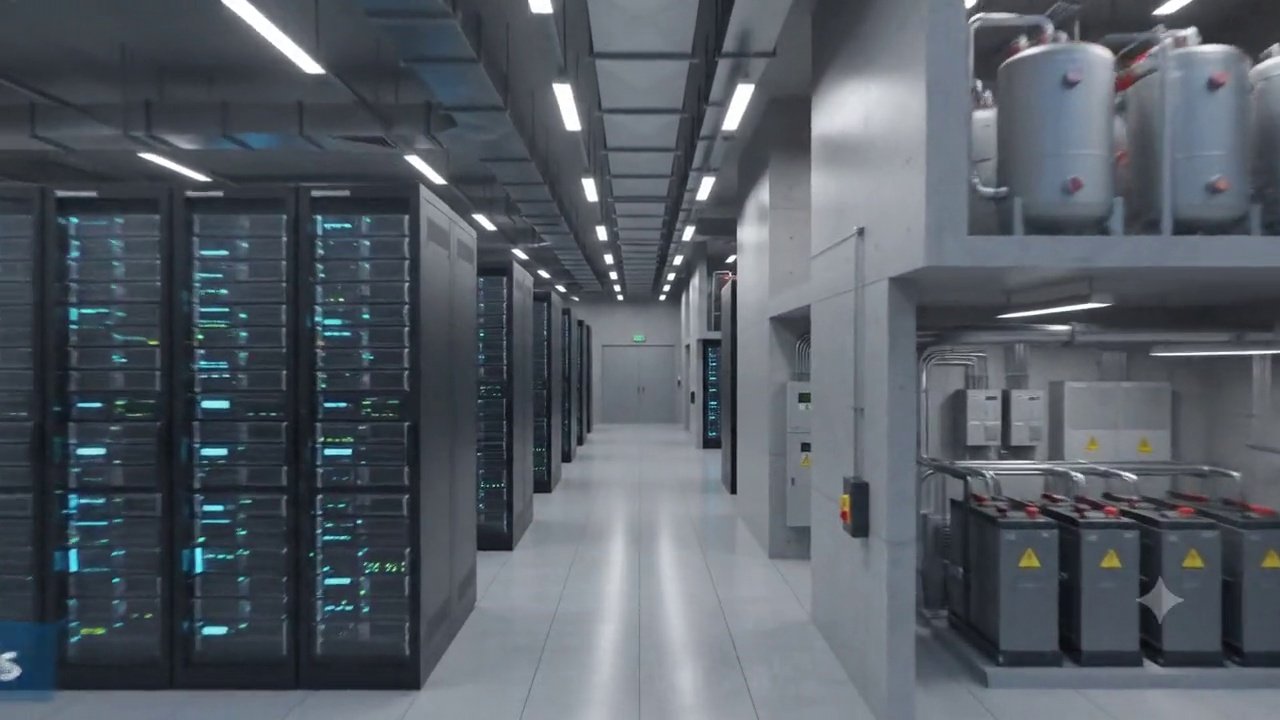
Sustainable by design
Cooling that gives heat back instead of throwing it away
At the core of the moat is AcquaNova water-to-water CO₂ cooling — engineered for tropical climates by the world's leading CO₂ heat-pump specialists, and buried where the earth keeps it stable.
The build
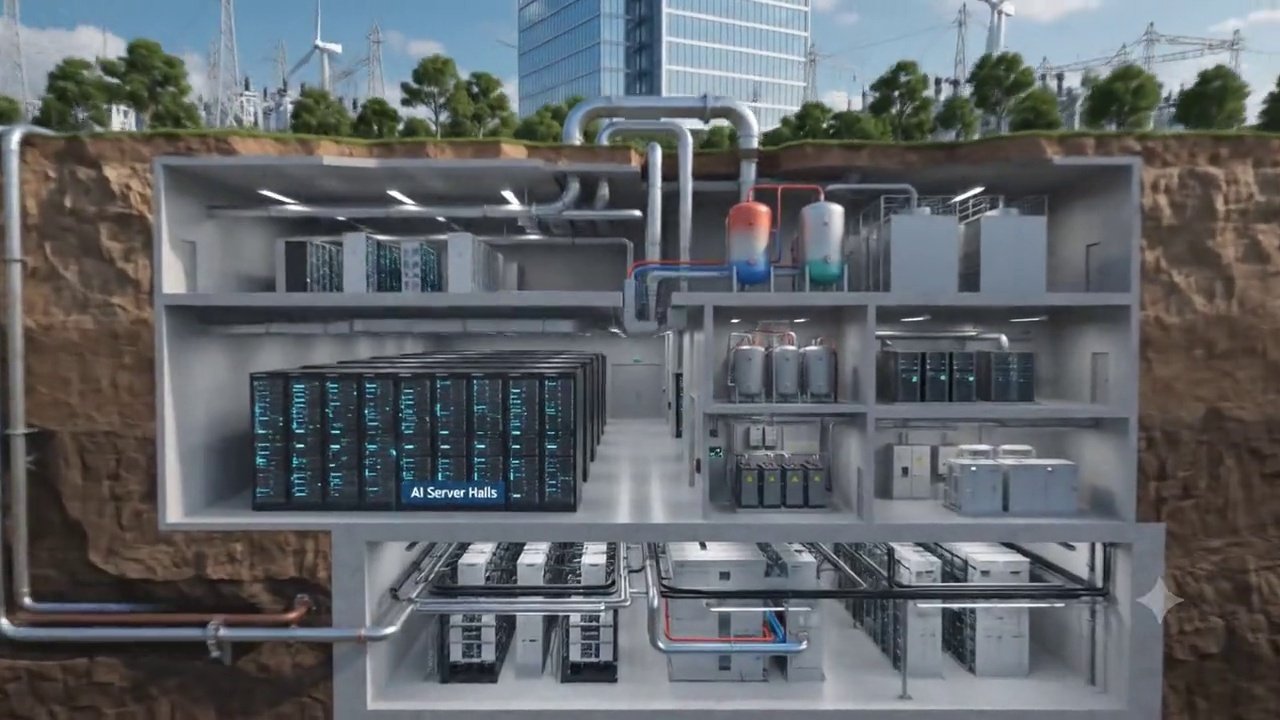
Built sixty-five metres down
Five basement levels of compute beneath a green-field surface of solar and wind. The earth does the thermal work; the site above stays quiet, low-footprint, and almost invisible.
The landscape
Cold-climate efficiency, in tropical India
The world's most efficient AI campuses lean on freezing Nordic air to hold their PUE down. We reach the same ~1.20 in hot, coastal India by burying the compute sixty-five metres beneath the heat — the earth does the insulating, so efficiency never depends on the weather.
| Format | Hardware fleet | Power source | Cooling & heat |
|---|---|---|---|
| SUBT3RRAUnderground · India | Tier-1 / Tier-2 GPU cascade | Surface solar + wind hybrid | Earth + CO₂, no chillers · PUE ~1.20 |
| US mega-hyperscalee.g. xAI Colossus | Centralized GPU clusters | Heavy pull from public grids | Air / water · needs new substations |
| Fluid immersionSubmerged tanks | Standard submerged GPUs | High public-grid demand | Dielectric fluid · needs fluid management |
| Nordic ‘arctic’ AICold-climate | High-compute clusters | Dedicated hydropower | Free cold air · climate-dependent |
And because the platform is a mesh across three state grids — Odisha, Tamil Nadu and Karnataka — the erratic power spikes of AI training are buffered across sites instead of dumped on a single substation.
The people
Operators, builders, and land
Enterprise infrastructure at hyperscale, finance built for scrutiny, and hands-on experience acquiring land and building across Indian states.
Mayukh Gon
Twenty-five years building at the intersection of software, automation and enterprise innovation — early engineering at Vocollect, SmartOps and SurePay, then consulting inside TD Bank, RBC, ING and IBM. Managing Partner at Nebula Capital and founder of Qalyx. At SUBT3RRA he owns capital, government relationships and the commercial pipeline.
Sharath Manjunath
Founder of ComFinTax Advisors in Bengaluru, leading a team of fifteen including three Chartered Accountants and two Company Secretaries. Close to a decade across audit, tax, CFO support and fundraising diligence, including leading finance at Melento. B.Com and MBA, at the final stage of both the CA and CS programmes.
Soumya Das Bhoumik
Twenty-two years architecting enterprise infrastructure at Microsoft and HPE — exabyte-scale storage, virtualisation, cloud infrastructure and core data platforms. His focus is now the infrastructure bottlenecks AI workloads expose. Specialised training in applied machine learning through MIT Professional Education; owns technical architecture across all three sites.
Arun Kumar Durairaj
Software architect and technology leader with thirteen years across healthcare IT and financial services — interoperability, EHR platforms and enterprise systems integration in environments where a regulator eventually reads everything. Alumnus of the IIM Calcutta Executive Programme; owns programme management and delivery across the platform.
Nijish Nair
A decade scaling Indian startups including OYO and Lendingkart, then founder of Swasya, a forty-acre regenerative eco-living community in the Western Ghats now expanding to five further locations. Brings direct experience acquiring land, securing approvals and building physical infrastructure across Indian states.
Technical partners & advisory
Hugo Alexander Jefferson
CO₂ cooling — 27 years across APAC and Europe.
Prof. Armin Hafner
World authority on CO₂ refrigeration.
SectorNorth Capital
Capital advisory and transaction support.